Blog24 March 2026
A curriculum built with direct industry input moves training from theoretical knowledge to operational readiness. Apprentices learn current tools, architectures, and workflows rather than outdated concepts, gaining exposure to real-world practices. It emphasizes problem-first thinking, focusing on solving business challenges rather than applying technology for its own sake. Crucially, it also prepares learners for real-world constraints such as messy data, limited infrastructure, regulation, and time pressure. Through live or simulated projects, apprentices develop practical decision-making, adaptability, and resilience that purely academic settings cannot provide.
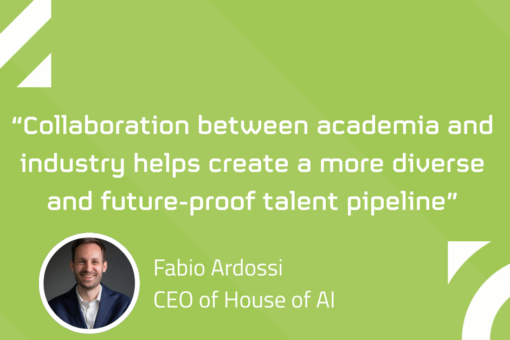
Collaboration between academia and industry helps create a more diverse and future-proof talent pipeline by broadening access and pathways into technology. It brings together different perspectives, experiences, and expertise, strengthening innovation and inclusion.
This partnership also accelerates feedback loops between emerging technologies and required skills, ensuring training stays relevant. While academia alone may lag behind and industry may struggle to scale training, collaboration bridges this gap. Importantly, it prioritises adaptable, transferable skills, such as experimentation, rapid prototyping, and cross-functional collaboration – over narrow specialisation, preparing individuals for evolving roles.
As technical roles rapidly change, real-time industry input keeps curricula current by shifting focus from static knowledge to dynamic capability, or “learning to learn.” Traditional academic cycles often cannot keep pace with technological change, particularly in AI.
Industry collaboration enables continuous updates, identifying which foundational principles should remain stable and which emerging skills must be integrated quickly. Industry can immediately signal the need for prompt engineering, AI safety, and human-in-the-loop design, and education providers can integrate these topics rapidly into programmes to create a forward-looking curriculum that prepares learners not just for today’s roles, but for roles that are still emerging.